About the tour
Three and a half hours through the historic centre: the great squares, the Neva embankments, the islands — and St Isaac’s Cathedral, the one stop on the route we go inside.
The route is driven, with stops for photographs and short walks. A single trip covers what would otherwise take a full day on foot.
What you will see along the way
Everything on the driving portion is seen from outside — at stops, from the car and from the best vantage points:
- Kazan Cathedral — a colonnade of 96 columns echoing St Peter’s in Rome, with Kutuzov’s tomb inside.
- Arts Square — the Russian Museum in the Mikhailovsky Palace, the Mikhailovsky Theatre, the Philharmonic, and the Pushkin monument at the centre of the garden.
- Gostiny Dvor — the city’s first and foremost department store, trading on the same site since the eighteenth century.
- The Field of Mars — a former military parade ground, home to the country’s first Eternal Flame.
- The Church on Spilled Blood — a church in the Russian style, built on the spot where Alexander II was assassinated.
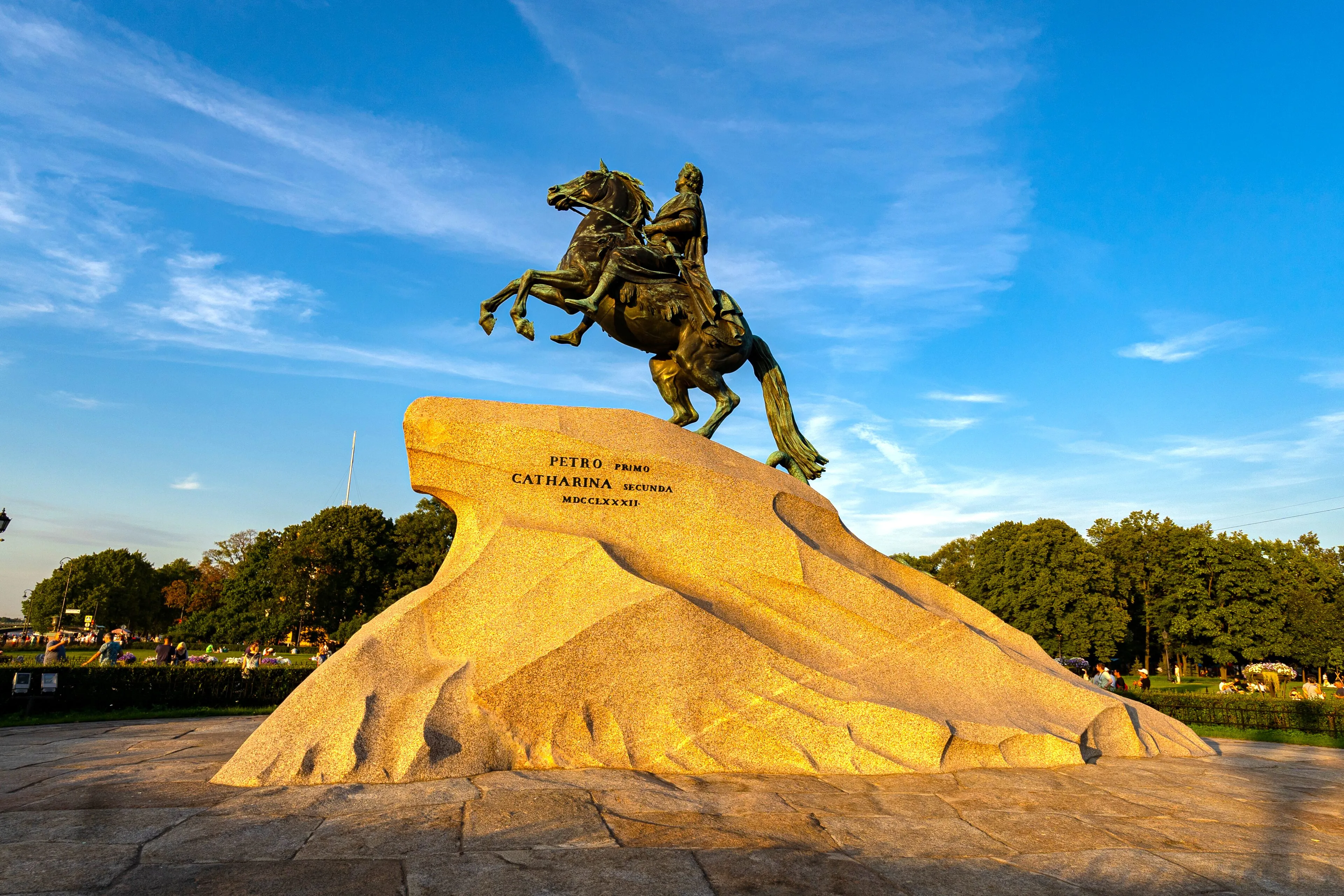
- Senate Square and the Bronze Horseman — the site of the Decembrist revolt of 1825 and the monument to Peter I that gave Pushkin’s poem its name.
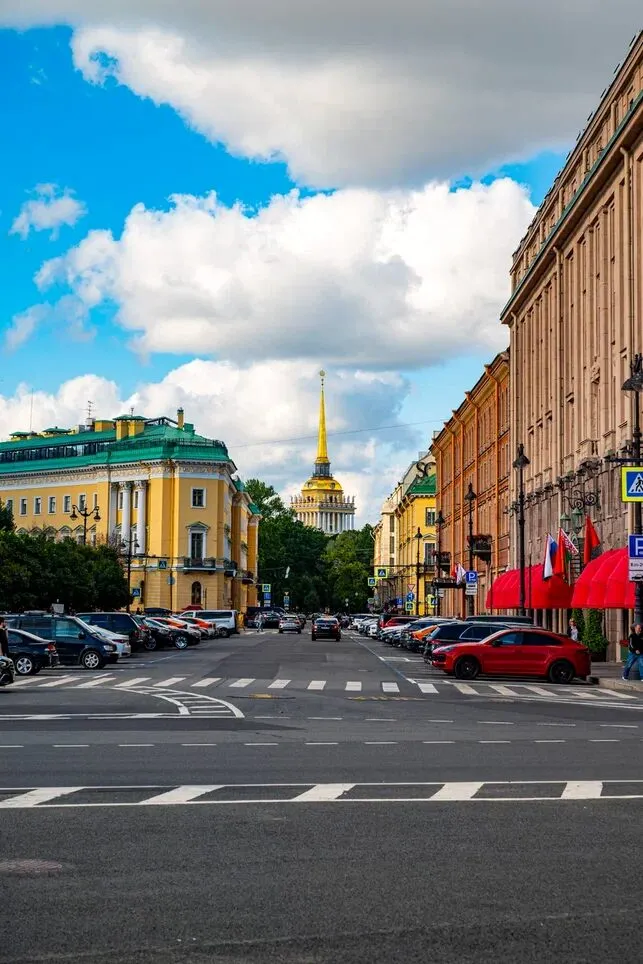
- The Hermitage and Palace Square — Rastrelli’s Winter Palace, the General Staff arch, and the Alexander Column, which stands unfixed under its own weight.
- The Spit of Vasilyevsky Island — the Rostral Columns, the old Stock Exchange, and the classic panorama of the city on both sides of the Neva.
- The cruiser Aurora — the ship whose shot signalled the storming of the Winter Palace in 1917.
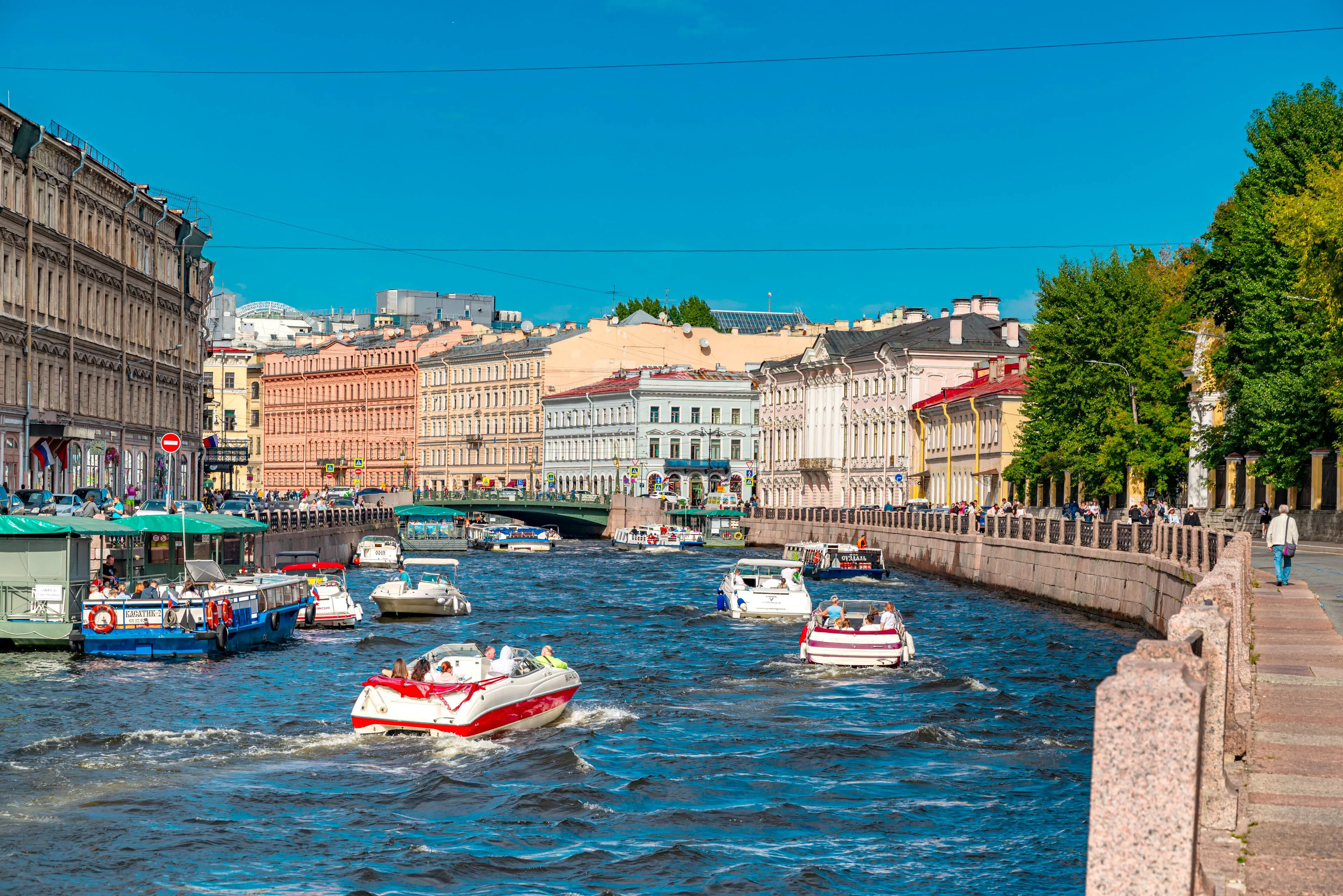
- Trinity Bridge and the University Embankment — views of the Peter and Paul Fortress, the sphinxes from Thebes, and the Neva perspective people come here for.
St Isaac’s Cathedral
The principal church of the Russian Empire took forty years to build, from 1818 to 1858, to a design by a young Frenchman, Auguste de Montferrand, whom Alexander I chose against professional advice. It is the fourth St Isaac’s church on the site: the first three either settled into the Neva subsoil or failed to satisfy their patrons.
The cathedral rises 101.5 metres and remains one of the largest domed churches in the world — it once held up to 12,000 people at a time. Beneath it are more than ten thousand piles driven into the marshy ground, and it carries 112 monolithic granite columns quarried near Vyborg. The portico columns were raised before the walls went up; each weighs around 114 tonnes, and lifting one took less than an hour.
The dome is metal, light by the standards of the age, and gilded by the fire-gilding method: it consumed about a hundred kilograms of pure gold, and the mercury vapour cost dozens of craftsmen their lives. Inside, the cathedral doubles as a museum of stone — malachite and lapis lazuli on the iconostasis, coloured marbles, jasper, porphyry. There is Bryullov’s painting on the dome vault, mosaics throughout, and a stained-glass window in the altar, a rarity in an Orthodox church.
In the Soviet period it housed an anti-religious museum, with a Foucault pendulum hung beneath the dome. During the Siege the cellars held the museum treasures of the suburban palaces: the enormous building was deliberately left uncamouflaged, since both sides used it to range their artillery. The shell marks on the columns of the western portico have been left as a memorial.
Why go with a guide
Nothing inside the cathedral is labelled with what is actually interesting: how the settling of the foundations was calculated, why clay pots went into the masonry, how the design was nearly built in an oriental idiom, and what the construction really cost the treasury. A guide pulls all of it into one account and ties the cathedral to the rest of the route, from Senate Square outside the window to Palace Square.
The tour is private and the pace adjusts to you. The climb to the colonnade is not included and can be paid for separately if you wish.