About the tour
Three and a half hours in which the city falls into a comprehensible order: first the ceremonial centre and the Neva embankments, then Hare Island, where all of it began.
The route is driven, with stops for photographs and short walks. A single trip covers what would otherwise take a full day on foot.
What you will see along the way
Everything on the driving portion is seen from outside — at stops, from the car and from the best vantage points:
- Kazan Cathedral — a colonnade of 96 columns echoing St Peter’s in Rome, with Kutuzov’s tomb inside.
- Arts Square — the Russian Museum in the Mikhailovsky Palace, the Mikhailovsky Theatre, the Philharmonic, and the Pushkin monument at the centre of the garden.
- Gostiny Dvor — the city’s first and foremost department store, trading on the same site since the eighteenth century.
- The Field of Mars — a former military parade ground, home to the country’s first Eternal Flame.
- The Church on Spilled Blood — a church in the Russian style, built on the spot where Alexander II was assassinated.
- St Isaac’s Cathedral — the largest domed church in the city and one of the largest in the world.
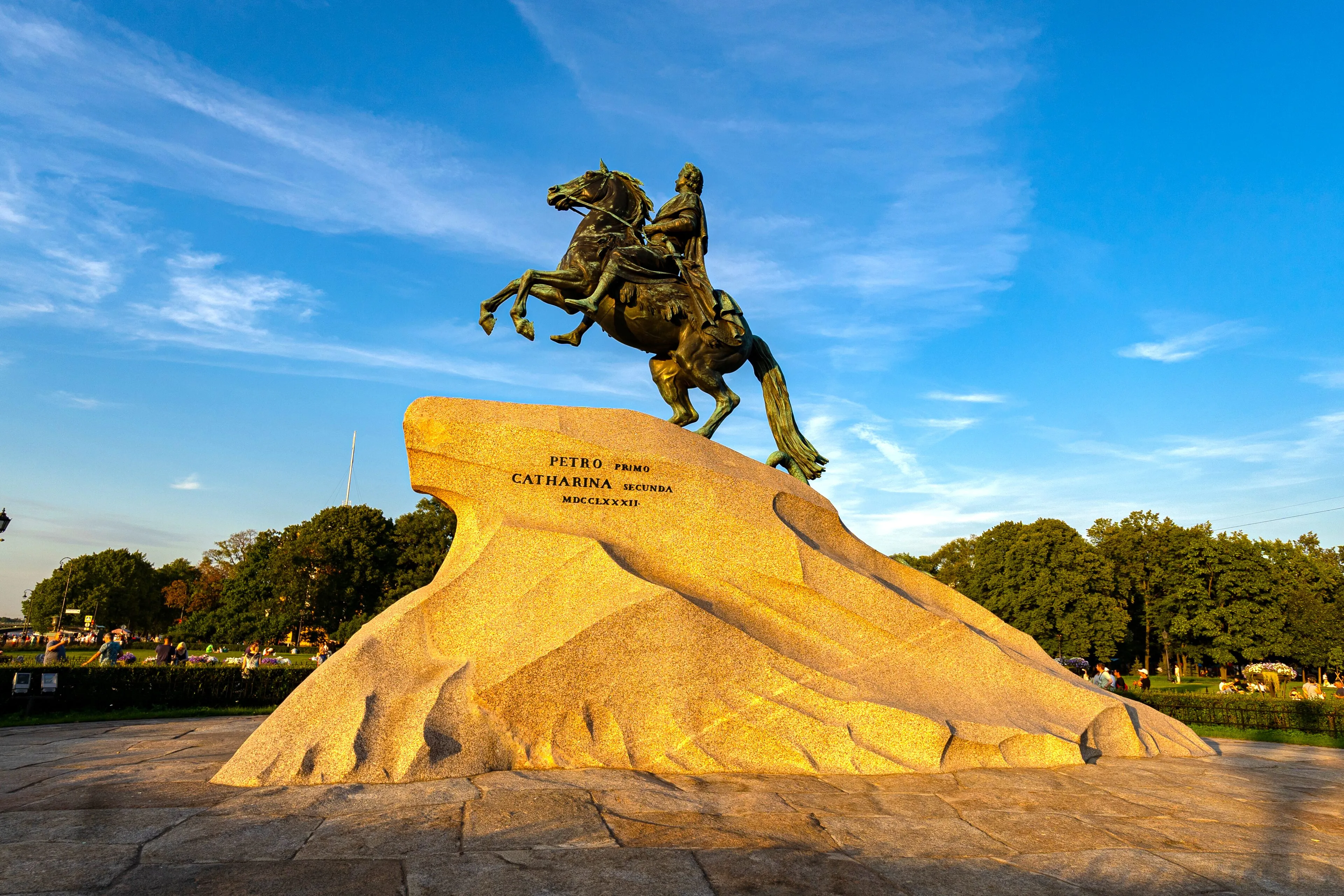
- Senate Square and the Bronze Horseman — the site of the Decembrist revolt of 1825 and the monument to Peter I that gave Pushkin’s poem its name.
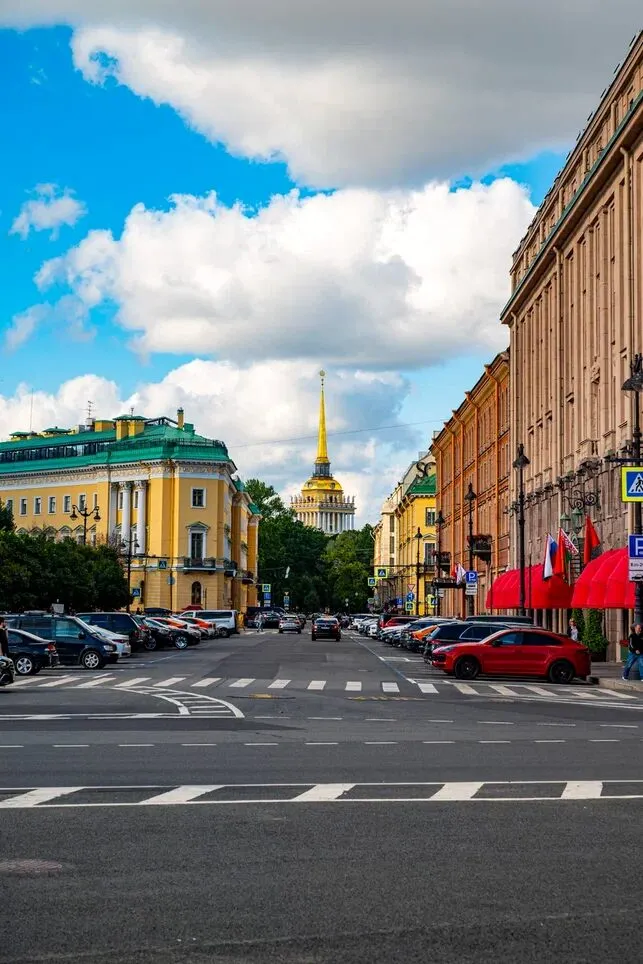
- The Hermitage and Palace Square — Rastrelli’s Winter Palace, the General Staff arch, and the Alexander Column, which stands unfixed under its own weight.
- The Spit of Vasilyevsky Island — the Rostral Columns, the old Stock Exchange, and the classic panorama of the city on both sides of the Neva.
- The cruiser Aurora — the ship whose shot signalled the storming of the Winter Palace in 1917.
- Trinity Bridge and the University Embankment — views of the fortress from the water, the sphinxes from Thebes, and the Neva perspective people come here for.
The Peter and Paul Fortress
On 16 May 1703 an earthwork fortress was laid down on Hare Island in the Neva delta, and that day counts as the birthday of St Petersburg. There was no city yet: the war with Sweden was under way, and the 28-hectare island commanded the entrance to the mouth of the Neva. The fortress went up in a single season, was then rebuilt in stone over thirty years — and never fired a shot in anger.
Inside, we walk the same way everyone who came to the island did three hundred years ago: across the Ioannovsky Bridge and through Domenico Trezzini’s Peter’s Gate, along the curtain walls between the six bastions — the Sovereign’s, Menshikov, Naryshkin, Trubetskoy, Zotov and Golovkin — to the cathedral and the river.
The Peter and Paul Cathedral took Trezzini twenty-one years, from 1712 to 1733, and he began not with the church but with the bell tower: Peter wanted his new capital to have a landmark on the skyline at once. The gilded spire with its angel rises to 122.5 metres. Inside is the Romanov burial vault, holding almost every Russian emperor from Peter I to Alexander III; in 1998 the remains of Nicholas II and his family were interred in the Catherine chapel.
The island’s second history is a prison one. Its first inmate was the son of the fortress’s founder: Tsarevich Alexei was brought here in 1718 and never left. The casemates went on to hold Radishchev, the Decembrists, the Petrashevsky circle including the young Dostoevsky, Bakunin, Chernyshevsky and, later, Maxim Gorky.
Every day at exactly noon a signal gun fires from the Naryshkin Bastion, a tradition kept up since 1873. If our timing is right, you will hear it.
Why go with a guide
The grounds are open without a tour, but on their own they are a set of old walls. A guide assembles it into one story: why Peter chose this particular island, how a bastion differs from a curtain wall, how the angel on the spire survived three restorations, and why the city was built here rather than somewhere convenient.
The tour is private and the pace adjusts to you. The walk around the fortress is on level ground and is comfortable with children.