About the tour
Three and a half hours in which St Petersburg comes together as a whole: the ceremonial centre, the Neva embankments, the islands — and one church we get out of the car and go inside.
The route is driven, with stops for photographs and short walks. That way a single trip covers what would take a full day on foot, without leaving you exhausted halfway through.
What you will see along the way
Everything on the driving portion is seen from outside — at stops, from the car and from the best vantage points:
- Kazan Cathedral — a colonnade of 96 columns echoing St Peter’s in Rome, with Kutuzov’s tomb inside.
- Arts Square — the Russian Museum in the Mikhailovsky Palace, the Mikhailovsky Theatre, the Philharmonic, and the Pushkin monument at the centre of the garden.
- Gostiny Dvor — the city’s first and foremost department store, trading on the same site since the eighteenth century.
- The Field of Mars — a former military parade ground, home to the country’s first Eternal Flame.
- St Isaac’s Cathedral — the largest domed church in the city and one of the largest in the world.
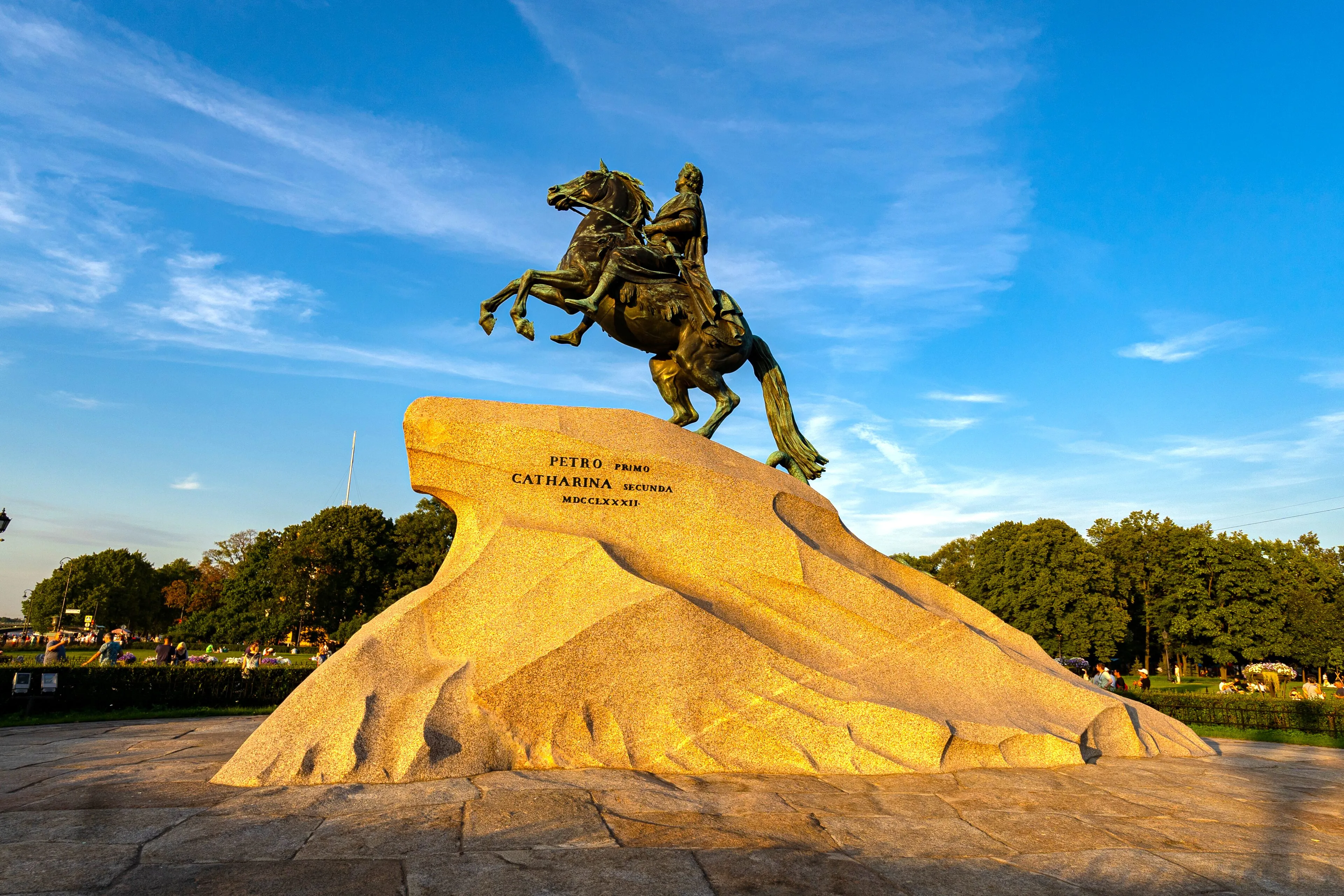
- Senate Square and the Bronze Horseman — the site of the Decembrist revolt of 1825 and the monument to Peter I that gave Pushkin’s poem its name.
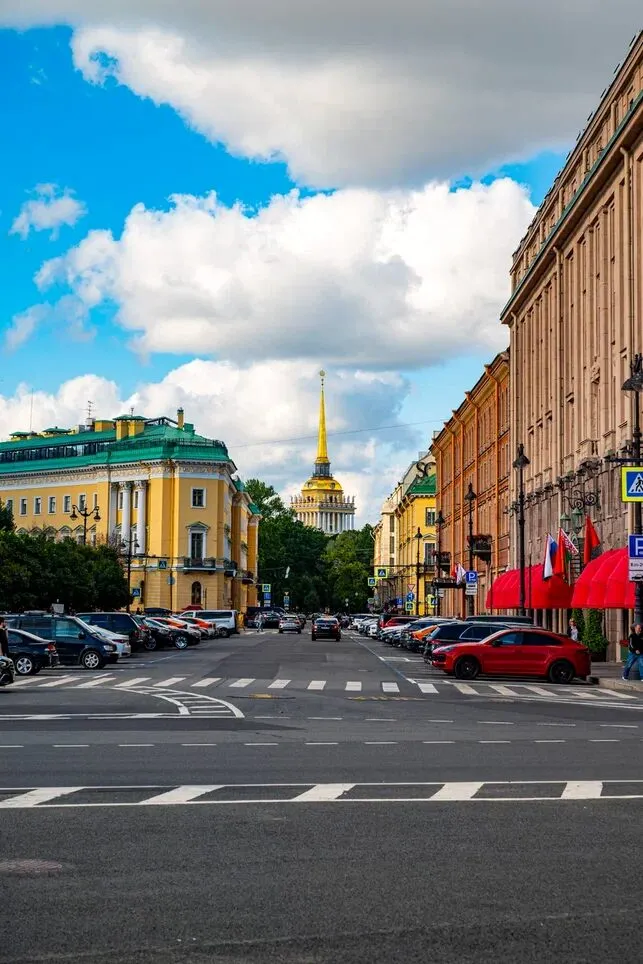
- The Hermitage and Palace Square — Rastrelli’s Winter Palace, the General Staff arch, and the Alexander Column, which stands unfixed under its own weight.
- The Spit of Vasilyevsky Island — the Rostral Columns, the old Stock Exchange, and the classic panorama of the city on both sides of the Neva.
- The cruiser Aurora — the ship whose shot signalled the storming of the Winter Palace in 1917.
- Trinity Bridge and the University Embankment — views of the Peter and Paul Fortress, the sphinxes from Thebes, and the Neva perspective people come here for.
The Church on Spilled Blood
On 1 March 1881, on the embankment of the Catherine Canal, a bomb thrown by Ignaty Grinevitsky of the People’s Will mortally wounded Emperor Alexander II — the tsar who had abolished serfdom. The City Duma resolved to commemorate the spot the very next day, and Alexander III insisted the church be built “in the Russian taste of the seventeenth century”.
The Cathedral of the Resurrection of Christ took twenty-four years to build to Alfred Parland’s design, from 1883 to 1907. It deliberately breaks with the austere classicism of St Petersburg: the multicoloured domes, tilework and kokoshnik gables are a direct nod to St Basil’s in Moscow. The church stands 81 metres tall, matching the year of the emperor’s death.
Inside is one of the largest collections of mosaic in Europe: some 7,000 square metres cover the walls, vaults and iconostasis. The work followed designs by Vasnetsov, Nesterov, Belyaev and others, and it was the mosaics that delayed the consecration by nearly a decade. The heart of the cathedral is the preserved section of pavement and canal railing where the emperor was wounded: to enclose it, the church was pushed out into the canal itself and the line of the embankment altered.
In the Soviet years the cathedral was closed and demolition was discussed; during the Siege and after the war it served as a warehouse, at one point for vegetables — which earned it the city nickname “the Saviour on Potatoes”. Restoration took twenty-seven years, and the museum opened in 1997.
Why go with a guide
A city tour without commentary is just a list of buildings. A guide ties the stops into a single story: how a marsh became a capital, why the city is laid out as it is, why the cathedral on Nevsky looks Roman while the church on the canal looks Muscovite. Inside the Church on Spilled Blood, your guide reads the mosaic cycles and the symbolism of the decoration — it is easy to be lost in there without them.
The tour is private and the pace adjusts to you. The route suits a first encounter with the city and works equally well as a full day for returning visitors.