About the tour
Two days, divided along the logic of the city itself: first St Petersburg proper — the centre, the fortress it grew out of, and the Hermitage — then the country residences, Peterhof and Tsarskoye Selo.
The split is not arbitrary. The first day fits entirely inside the historic centre; the second needs a car and two long transfers, so combining them would only produce a race. Kept apart, they add up to a coherent story: where the imperial family worked and received, and where it rested.
Day one: the city, the fortress and the Hermitage
The morning goes to the centre and the Peter and Paul Fortress, the afternoon to the Hermitage.
- The Church on Spilled Blood — built on the spot where Alexander II was fatally wounded on 1 March 1881. Alfred Parland’s design took twenty-four years to build: begun in 1883, consecrated in 1907. It stands 81 metres tall, matching the year of the emperor’s death. Inside are some 7,065 square metres of mosaic, one of the largest collections in Europe, and beneath a canopy the preserved section of the actual pavement, with the railing beside which it happened.
- The Peter and Paul Fortress — founded on 27 May 1703, the date taken as the founding of St Petersburg. It never once fought: from the outset it served as a political prison, holding the Decembrists and nearly every notable case of the following century.
- The Peter and Paul Cathedral — Domenico Trezzini spent twenty-one years on it, from 1712 to 1733. Its gilded spire with the flying angel remained the tallest structure in the city for a long time. It is also the Romanov burial vault, from Peter I to Nicholas II, whose remains were reinterred here in 1998.
- The noon gun — the tradition of marking midday with a cannon from the Naryshkin Bastion dates to 1736 and became a daily fixture in 1873.
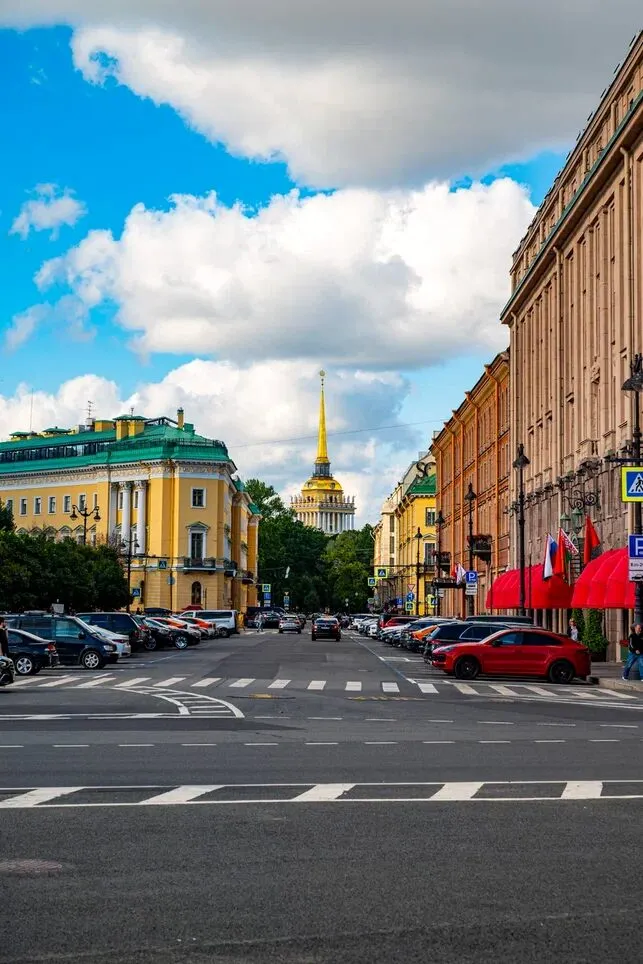
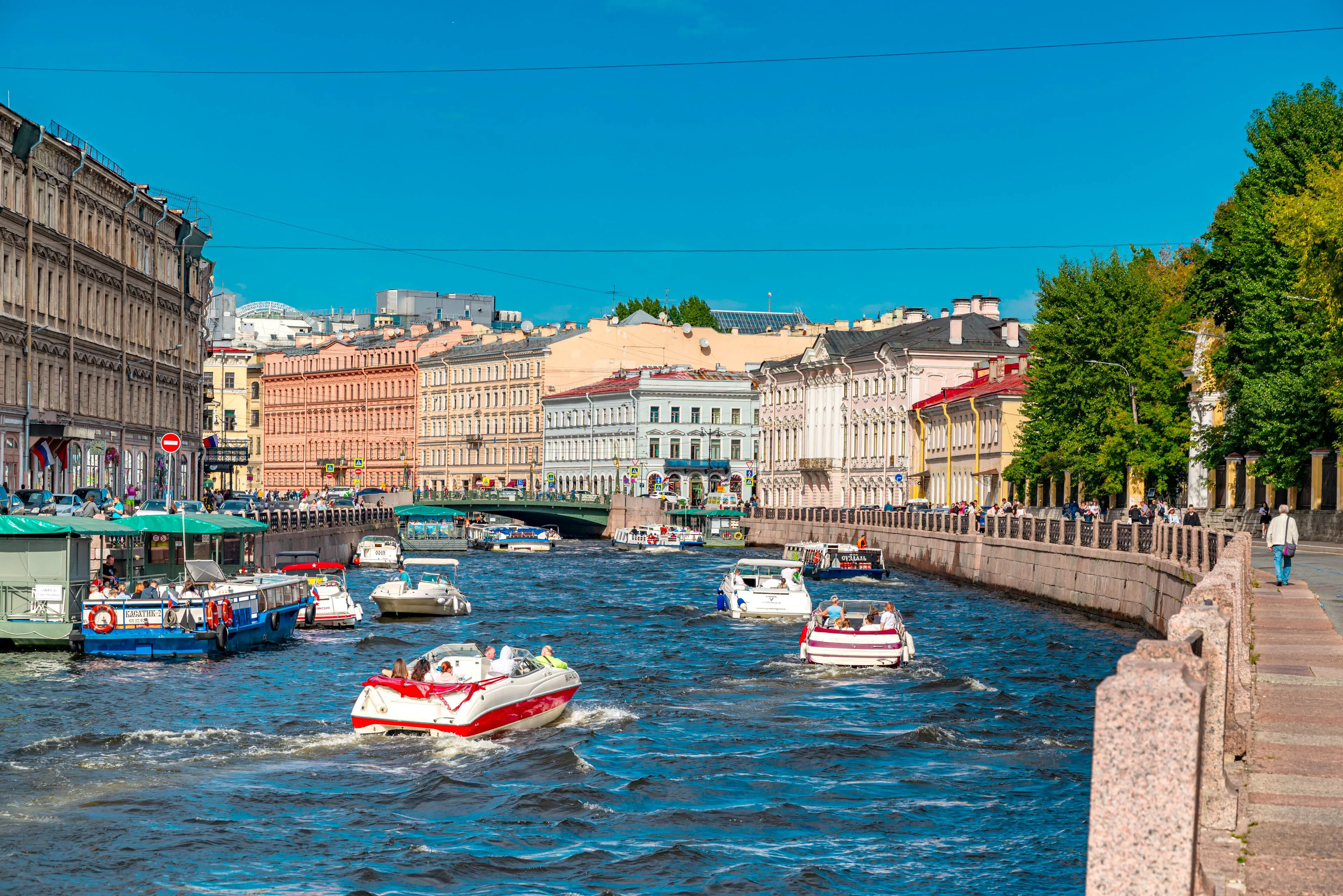
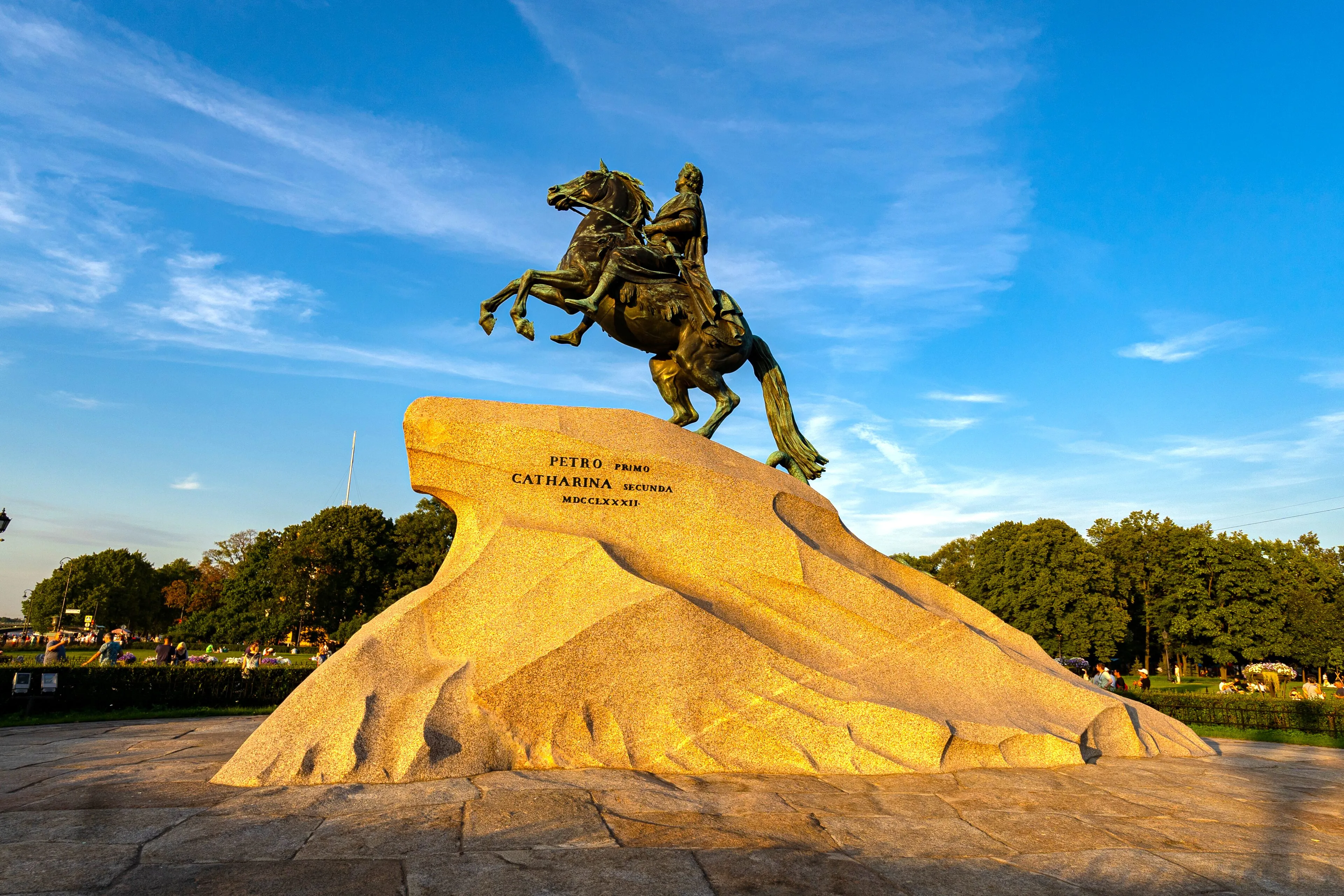
- Nevsky Prospect and the embankments — the great squares, the views across the Neva and the key buildings of the centre, seen along the way with stops for walking and photographs.
The Hermitage
The museum dates itself to 1764, when Catherine II took 317 paintings from the Berlin merchant Johann Ernst Gotzkowsky against his debt to the treasury, for 183,000 thalers. The collection now holds around three million items, and the complex consists of six connected buildings: the Winter Palace, the Small, Old and New Hermitages, the Hermitage Theatre and the Reserve House. Some 365 halls are open to visitors.
None of that can be covered in a single visit, so we take the ceremonial route: the Jordan Staircase, the throne rooms where receptions and official ceremonies were held, the Hanging Garden built at Catherine II’s instruction, and the Raphael Loggias — an exact copy of the Vatican gallery, commissioned by the same empress.
One stop deserves its own mention: the Peacock Clock. The English mechanic James Cox made it in the 1770s, Potemkin bought it for Catherine II in 1777, and it reached St Petersburg dismantled — “a heap of parts in baskets”, some of them lost on the way. Ivan Kulibin put it back together. It is the only large eighteenth-century automaton to survive unaltered, and it still runs: the mechanism is wound on Fridays, and the peacock spreads its tail, the owl rings its bells and the cockerel crows.
Day two: Peterhof and Tsarskoye Selo
- The Lower Park at Peterhof — 147 fountains and not a single pump: the water arrives by gravity from the Ropsha springs twenty-four kilometres away. The canal was dug from January 1721, the water reached the park on 8 August that year, and the system has run on the difference in elevation ever since. The park itself covers 102 hectares along the gulf.
- The Grand Cascade and Samson — the figure was installed in 1735 in memory of the victory at Poltava in 1709: the battle fell on St Sampson’s day, and the lion Samson is tearing open is the coat of arms of Sweden. The original vanished during the war; the present one was returned to its place on 14 September 1947.
- The Catherine Palace — laid down in 1717 and given its present form by Rastrelli, who rebuilt it between 1752 and 1756. The facade runs 325 metres, and the gilding of the exterior decoration took more than a hundred kilograms of gold.
- The Amber Room — the panels were begun in 1701 for the Prussian king Friedrich I, and in 1716 Friedrich Wilhelm I gave them to Peter I. They were installed at Tsarskoye Selo from 1743 under Empress Elizabeth, and the room reached its final form by 1770. In October 1941 it was removed to Königsberg, where the trail goes cold after April 1945. The recreation ran from 1981 to 2003 and opened for the city’s tercentenary.
How the two days run
Day one
- 9:00 — meet your guide in the hotel lobby
- 9:00–12:00 — the centre, the Church on Spilled Blood and the Peter and Paul Fortress
- 12:00–13:00 — lunch (paid separately)
- 13:00–16:00 — the Hermitage. The museum may shift the entry slot in order to spread visitor flow
- 17:00 — return to your hotel
Day two
- 9:00 — meet your guide in the hotel lobby
- 9:30–10:45 — transfer to Peterhof (optionally by hydrofoil, at extra cost)
- 10:45–12:15 — walk through the Lower Park and the fountains
- 12:30–13:30 — lunch (paid separately)
- 13:30–14:30 — transfer to Pushkin
- 14:30–16:30 — the Catherine Palace and the Amber Room
- 17:30 — return to your hotel
Why go with a guide
The hard part of a two-day itinerary is the timetables. The Hermitage and the Catherine Palace admit visitors in timed slots, the fountains have their own schedule, and all of it has to be squared with two trips out of the city. We take on the tickets, the timing and the order of the visit, so you are neither queueing nor bending your day around someone else’s schedule.
The tour is private: the pace and the length of each stop adjust to you, and if you want to stay longer in the Hermitage on the first day, the programme can be reshaped as you go. Lunches are not included, and the hydrofoil to Peterhof is paid separately if you want it.